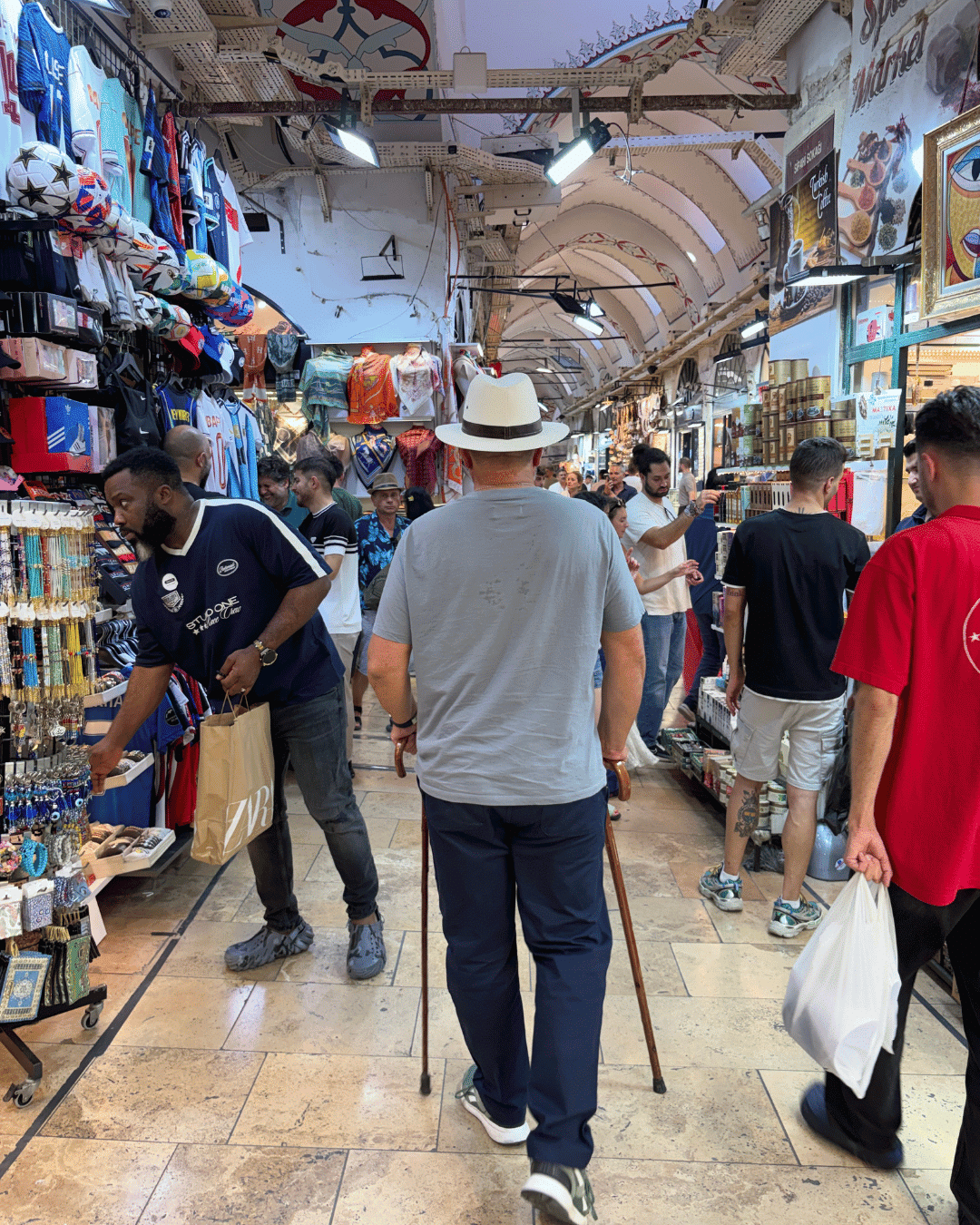
So, one of life’s curveballs this year has been a reduction in my hubby’s mobility due to a back injury. Having already booked a two-centre holiday to Turkey, we got a wheelchair. We stayed in the Old City in Istanbul before heading on an internal flight to the rocky coastline of Kalkan.
I’ve had a crash course in accessibility.
Apart from travelling with my brother on several occasions – he has a learning disability – I’d never travelled with a wheelchair user. I’ve learnt that wheelchair users are treated very differently from country to country.
In Istanbul, he was very efficiently picked up in a motorised wheelchair by an operator, leaving me literally running behind to catch up. Only to be abandoned shortly after the air bridge inside the terminal, waiting for a multi-person buggy to collect us. Two went past full, and half an hour later we were deposited in another holding area, waiting for assistance to go through passport control. Eventually, we found our wheelchair in oversized luggage after waiting for all the luggage to be unloaded from the carousel, and the next flight’s luggage had already started to go round.
As the taxi wound its way through Istanbul, crossed the Bosphorus, and climbed up and down the hilly Old City, we realised we had to abandon the wheelchair altogether.
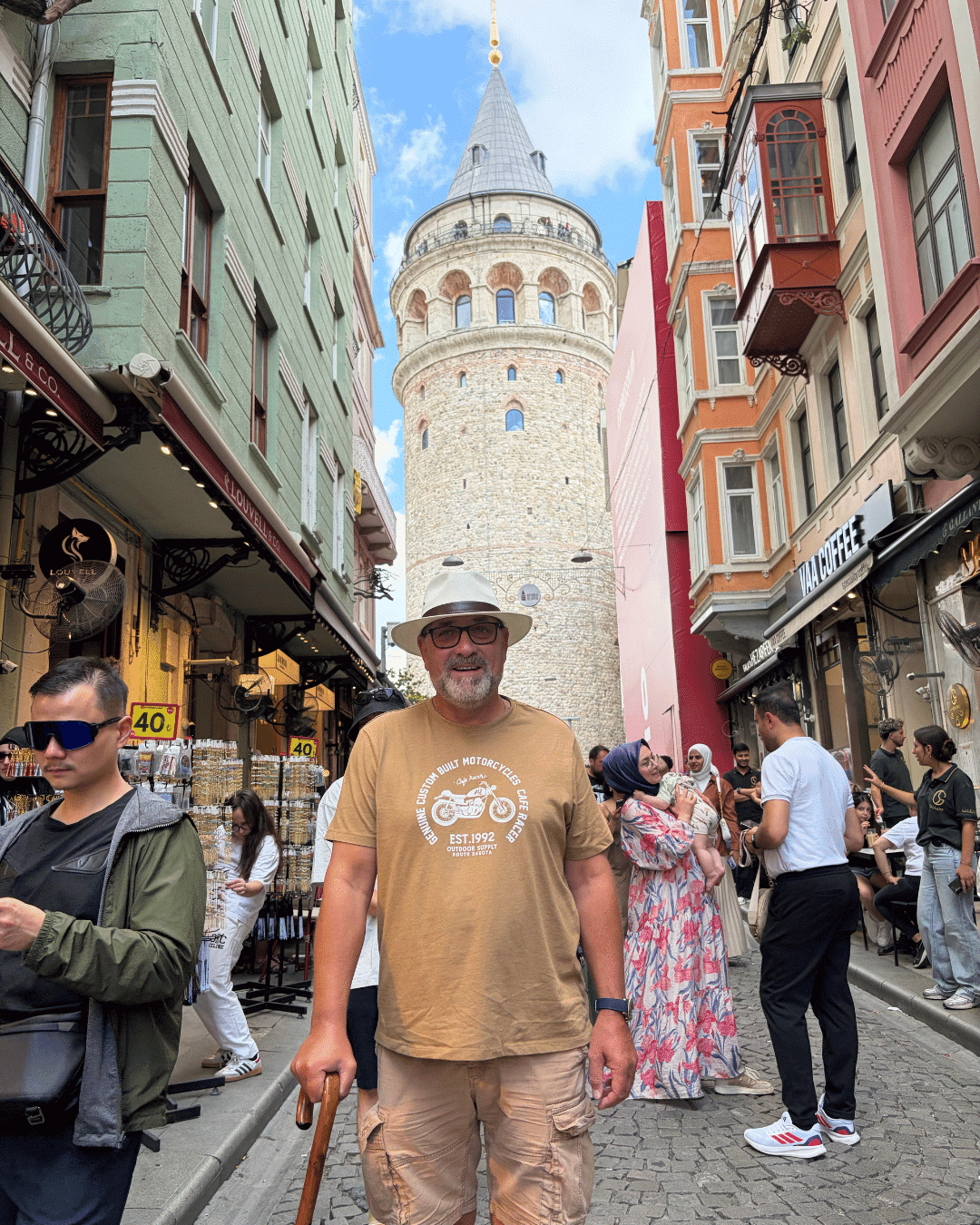
But even though there wasn’t a level threshold anywhere in Istanbul that we went, the city was so well served by public transport that it didn’t matter. There was a tram stop at the end of our street, and the ferry port was next to a tram stop. Istanbul really opened up to us. We cruised up, down and across the Bosphorus, ventured to the Princes’ Islands, but had to admit defeat at the Galata Tower. Hubby was happy to stop for a beer while I climbed the stairs to the viewing platform.
A few days later, we headed back to Istanbul Airport. With the benefit of experience, we refused to let go of the wheelchair and declined the offer of “special assistance”. This time, we took the chair right to the gate and collected it again from the gate in Dalaman.
Once ensconced at Likya Gardens in Kalkan, we again abandoned the wheelchair, instead using local taxis to negotiate the hillside harbour town and limiting our trips between the cliffside beach and our hotel room with its own private pool. My health app kept reminding me that I’d only walked about half my usual daily step count. It was blissfully relaxing.
The main thing I’ve learnt about accessibility is that every new place has a different way of working and its own challenges. As the partner of a wheelchair user, I found myself handling all the baggage, running after him, or getting my toes stepped on as people tried to help him by moving furniture out of the way.
It should be part of an architect’s education to spend a day either in a wheelchair or helping someone who uses one. The same goes for pushing a pushchair or navigating a building without sight.